Margaret Tobin Brown was born on 18 July 1867 in Hannibal, Missouri, to Irish immigrants John Tobin and Johanna Collins. She grew up near the Mississippi River and worked stripping tobacco leaves as a teenager before moving to Leadville, Colorado, where on 1 September 1886 she married James Joseph „J.J.“ Brown at Annunciation Church. The couple had two children, Lawrence Palmer (b. 1887) and Catherine Ellen „Helen“ (b. 1889); Margaret also helped raise three daughters of her brother Daniel after their mother’s death. J.J. Brown’s mining ventures brought the family considerable wealth, and Margaret became a prominent civic figure in Denver: she helped found the Denver Woman’s Club, supported Colorado’s National American Woman Suffrage Association, raised funds for the Cathedral of the Immaculate Conception and St. Joseph’s Hospital, and worked with Judge Ben Lindsey to help establish the first juvenile court system in the United States. In 1914 she organised an international women’s rights conference with Alva Vanderbilt Belmont, and in 1932 she was awarded the French Legion of Honor for her civic and humanitarian work.
In April 1912, Margaret booked First Class passage aboard the RMS Titanic, ticket number 17610 (£27 14s 5d), boarding at Cherbourg on 10 April 1912. She was travelling to New York after learning that her first grandchild was ill; her daughter Helen remained in London.
When the Titanic struck the iceberg on the night of 14 April 1912, Margaret helped other passengers into the lifeboats before being persuaded into Lifeboat 6. Aboard the boat she helped row through the night and worked to keep up the spirits of the other occupants. Once aboard the rescue ship Carpathia, she used her fluency in French, German and Russian to assist fellow survivors, helped establish and chaired the Survivors‘ Committee, and raised close to $10,000 for survivors left destitute by the disaster, remaining aboard until all survivors had received proper care. On 29 May 1912 she presented Carpathia’s Captain Arthur Rostron with a silver loving cup and medals for the crew.
In the years that followed, Margaret helped erect the Titanic memorial in Washington, D.C., continued her work with the Survivors‘ Committee, wrote her own account of the disaster for newspapers, and later worked with the American Committee for Devastated France during the First World War. Although she became known in popular culture decades later as the „Unsinkable Molly Brown,“ this nickname was never used during her own lifetime; it originated from a fictionalised 1930s account and was later popularised by a Broadway musical and Hollywood film.
Margaret Tobin Brown died on 26 October 1932 in New York City of a cerebral hemorrhage, at the age of 65. She is buried at Holy Rood Cemetery, Long Island, New York, beside her husband J.J. Brown, who died in 1922.
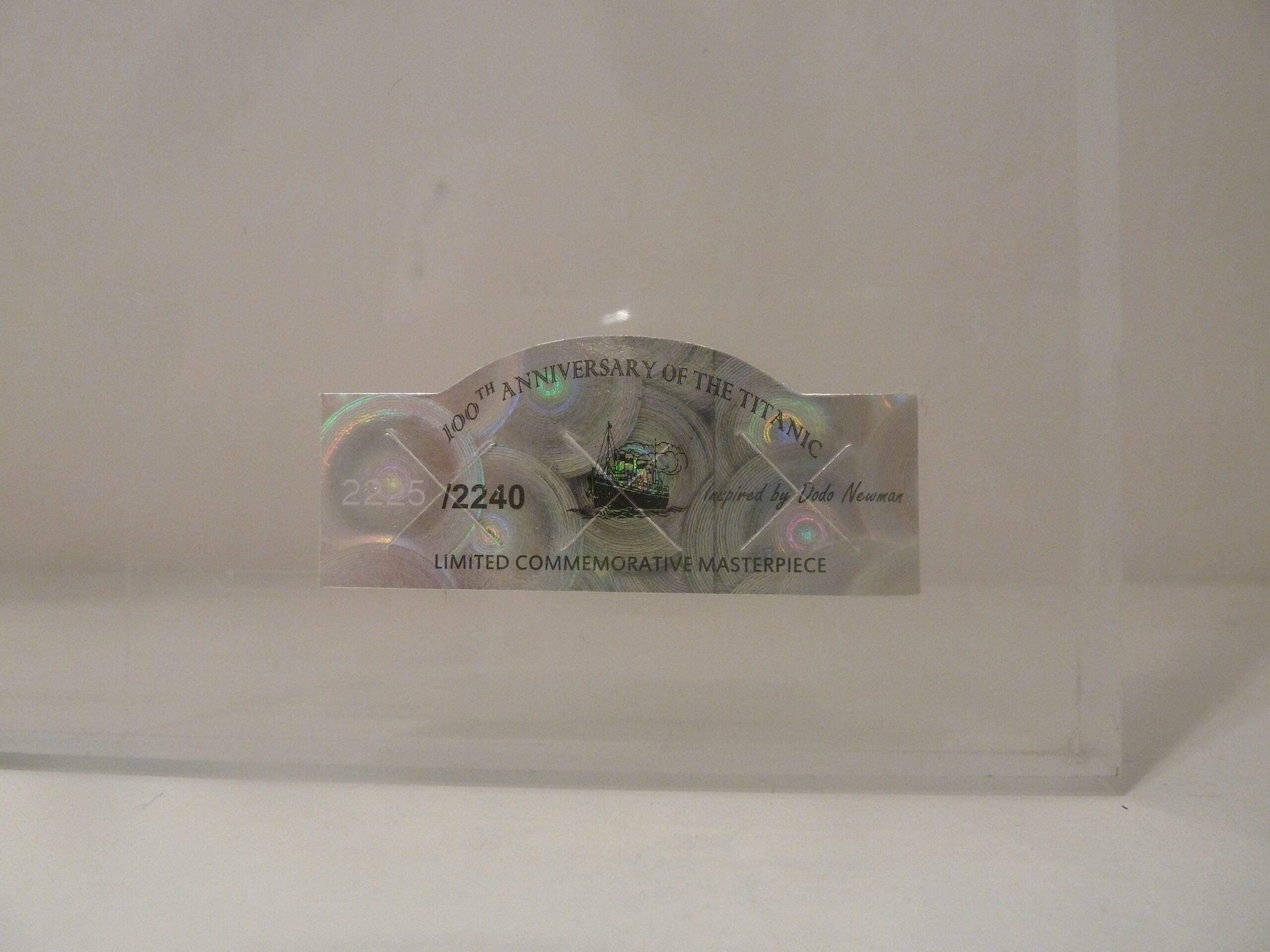
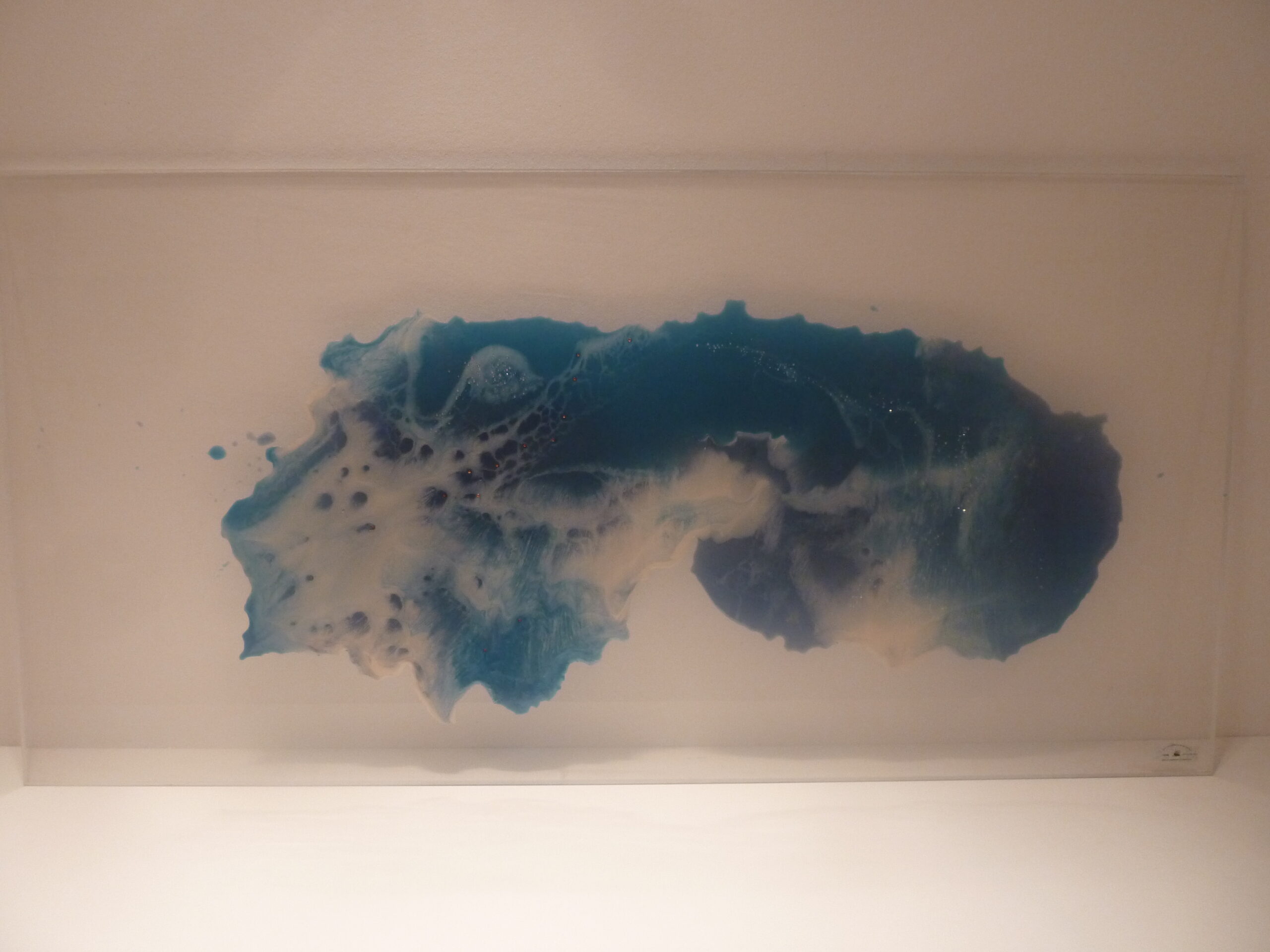
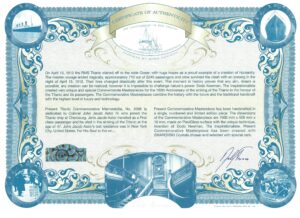
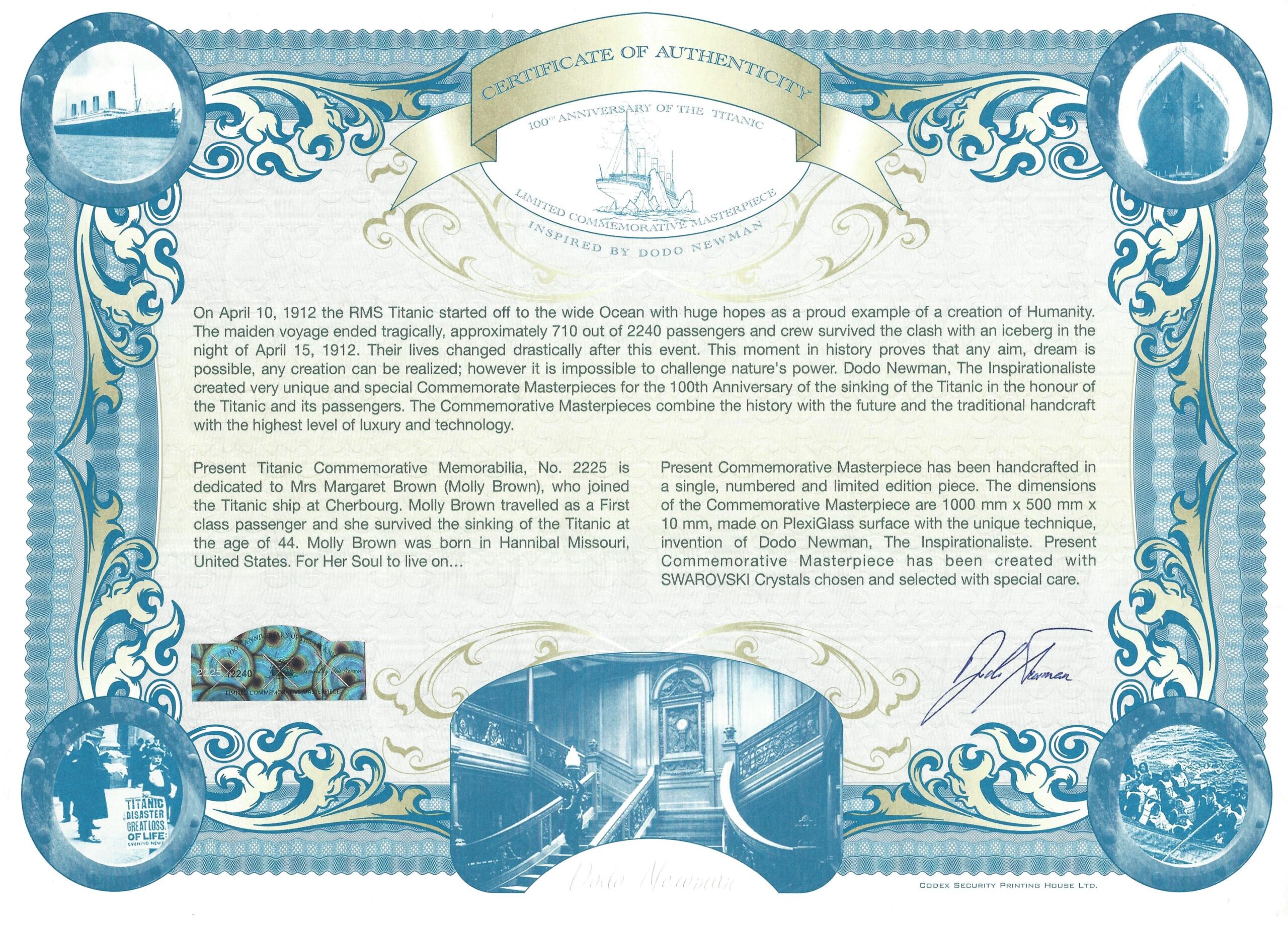
This artwork, Titanic Commemorative Memorabilia No. 2225, is dedicated by artist Dodo Newman to the memory of Margaret Brown as part of the 100th Anniversary of the Titanic collection, handcrafted on PlexiGlass with Swarovski crystals.
Sources: Encyclopedia Titanica (Margaret Brown survivor biography and facts); Certificate of Authenticity, Titanic Commemorative Memorabilia No. 2225 (Dodo Newman).